
NX91413 Lance Corporal
Albert John Spencer
"Spen" or "Spencer" READ
3rd Pioneer Company
30 Employment Company
30 Works Unit
8th Prisoner of War Reception Camp
3rd Prisoner of War Reception Group
This file last updated 3 December, 2025 11:46
Introduction

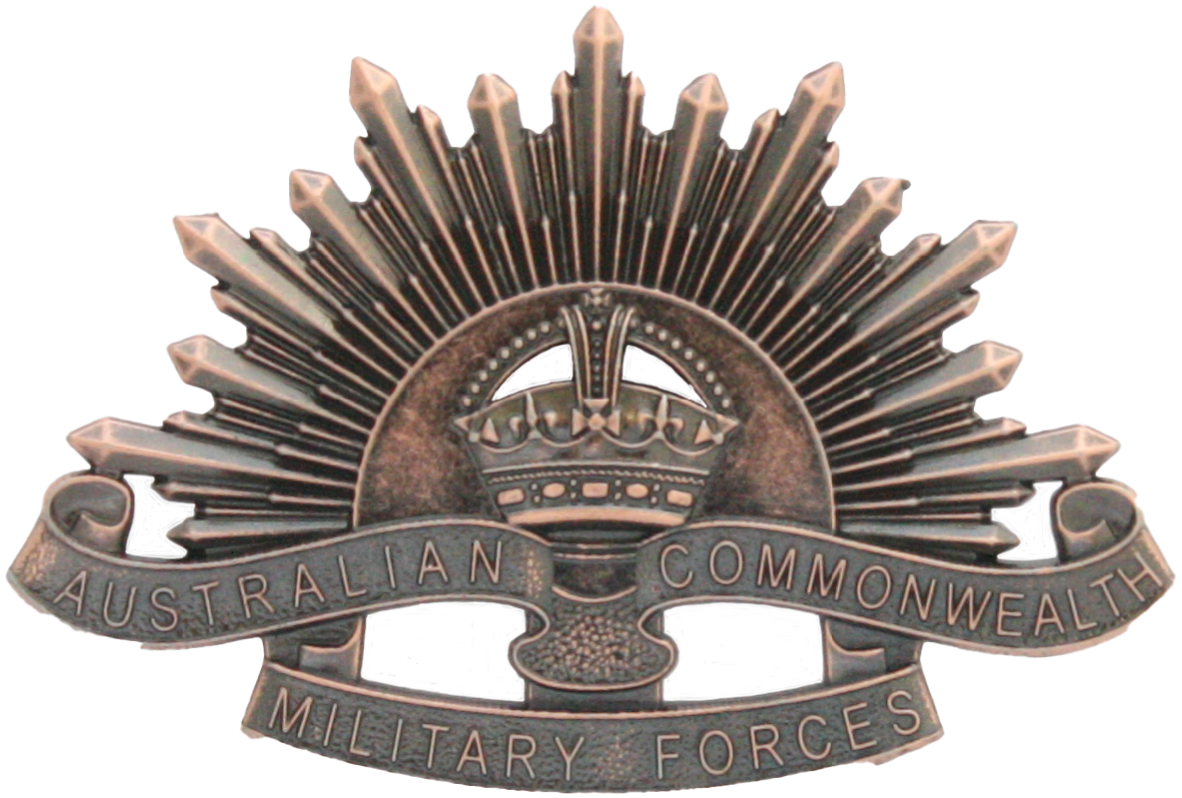
Lance Corporal Albert John Spencer Read on enlistment
The following information and chronological table is the WW2 Service record of Albert John Spencer (known as "Spen" to his family) READ b 15 Jun 1901, the son of Albert Jesse READ and Henrietta Louisa LEWIS who married 6 Jan 1899.
He married Edith Helena SAYWELL, daughter of Arthur James and Gertrude May SAYWELL 6 Jul 1929. Edith died on 18 Aug 1971 as the result of a vehicle acccident six weeks before.
Spencer married Doris REID in 1973. He died 3 Feb 1985 at PORT MACQUARIE.
Spencer enlists in the Army in Paddington NSW on 6 Mar 1942 at the age of 38, giving his occupation as Commercial Traveller and is allotted to the Royal Australian Engineers and while initially sent for training with the 8th Infantry Training Battalion he is immediately transferred to the 3rd Pioneer Company.
Within 20 days he is detached to the 5th Ordnance Ammunition Company spending about 7 weeks with that unit before returning to the Pioneer Company for further training.
On completion of that training he embarks from TOWNSVILLE to PORT MORESBY where he serves with the 30th Employment Company, a maintenance unit which is described below, following his service record.
He returns to TOWNSVILLE in June 1943 and remains with that unit until Jan 1945 when he is shipped out to MOROTAI where he serves with the 30th Works Company, which appears to be exactly the same unit he served with in NEW GUINEA, renamed, the Works and Employment titles apparently being interchangeable.
In August 1945 he is transferred to the 8th Australian Prisoner of War Reception Camp on MORATAI and less than a week later embarks for MANILLA and transfer to the 3rd Prisoner of War Group.
The move to MANILLA is overtaken by events, with repatriation of Australian Prisoners of War from there being completed by the end of October 1945. [Extract from 2nd/4th Machinegun Battalion web site.]

Spencer and Edith Read
This is confirmed by an article in the Brisbane Telegraph of Sat 13 Oct 1945 which states that "All Australian prisoners of war will have been evacuated from Manila [sic] by Monday. Four Catalinas and one Liberator left at dawn today with 88 former prisoners, and the final 58 will be taken out on Sunday or Monday Morning at the latest".
He is in MANILLA for less than a month and embarks from there on the "WILLIAM E CHANNING" to SYDNEY and is discharged due to demobilisation on 5 Dec 1945.
NB. Research on the "WILLIAM E. CHANNING" shows that it is decommissioned in 1942. I suspect a typo may be at work.
After the war Spencer and Edith go into partnership in an uphostery business expanding later into electrical and furniture, with two furniture stores in FAIRFIELD.
In addition to his businesses he is a respected senior Rotarian as Fellowship Chairman and a volunteer youth dressage trainer at Bossley Park Pony Club as well as a highly valued member of the West Pittwater Voluntary Fire Brigade.
See Spencer Read's Service Record.
He is the brother of Geoffrey Gordon READ whose military biography is here.
Abbreviations and Acronyms
Abbreviations or acronyms which have a dotted underline can be expanded by moving the cursor over the term - e.g. WIA. The cursor will be replaced by ? and the expanded abbreviation will be displayed. This is gradually being incorporated into the site, replacing the the current expansion of abbreviations. There may be a discernable delay of about a second before the expansion is first provided.
There is also a separate list of abbreviations which is available through the menu at the top of this page or the hyperlink here. Abbreviations are inconsistent, even within a single occurence where a term is abbreviated.
There are a number of sources for tracing abbreviations used in Australian and New Zealand service records. Those used when operating with the British or US forces can generally be found, especially in World War 1. Abbreviations used solely within Australia in WW2 are most difficult to trace, particularly when they are regional. Sometimes a 'best guess' is the only answer.
Duplicated Pages
Some of the service information may appear to be duplicated although individual occurrences are not in the same order and different abbreviations used. This occurs when the unit and Army records are amalgamated upon discharge or death in Service.
Service Numbers
Service numbers in WW1 were unique to the unit (e.g. Battalion) or Corps (e.g. Artillery). In WW2 Service Numbers were unique to the State in which they were allotted. For further information about identity numbers for Service personnel, see Regimental and Service Numbers
Dates of Occurrence and Reporting
The date of reporting an incident may be hours, days or months after the date on which incident actually occurred.
The original service record is amended only when the incident is reported which means that events are not necessarily recorded in in strict chronological sequence. This is the date shown on the left of the page of the original record, and also on the left in my transcription but readers should note that at times there may be no date of reporting at all, particularly when service personel are repatriated for discharge at the end of hostilities.
To assist the reader, when transcribing the military record I have done my best to record events in their chronological sequence. This is date is on the right of the page of the original record and also on the right in my transcription.
For clarity I have transcribed all dates into the format d MMM yyyy.
X List
Members of a unit who are temporarily detached to attend courses, seek treatment of illness, injury or wounds or for some other reason are marked X in the roll book which means that no rations are drawn by the unit for that person.
When those members return to their parent unit they are removed from the X List and rations are again drawn for them.
Should they be permanently removed from their parent unit, their posting order authorises their removal from roll-book of that unit and their addition to the roll book of the gaining unit unless they are discharged.
Enlistment Details
AUSTRALIAN MILITARY FORCES.
ATTESTATION FORM.
FOR SPECIAL FORCES RAISED FOR SERVICE IN AUSTRALIA OR ABROAD
Army Number......................NX90413...............
Surname..........READ........................Christian Names.............ALBERT JOHN SPENCER.....................................................................
Unit.......... 1 GEN INF TRG BN..................................................................................................................................................................
Enlisted for service at..................NSW............................................................................................................................................(Place)
...................QLD......................................................(State)...................... 6 JUN 1940.....................................................................(Date)
A
Questions to be put to persons called out or presenting themselves for voluntary enlistment*
1. What is your name? |
1. Surname READ |
2. Where were you born? |
2. In or near the town of MELBOURNE in the state or country of VICTORIA |
3. Are you a British Subject? |
3. NB |
4. What is your age and date of birth |
4. Age 38-8/10 mths |
5. What is your your normal trade or occupation |
5. Commecial Traveller |
6. Are you married, single or widower? |
Married 3 children 1/11 yrs |
7. Give details of previous military service |
1/10 yrs |
8. If now serving, give particulars |
8. Overwritten "NIL" |
9. Who is your actual next of kin? (Order of relationship.— wife, eldest son, eldest daughter, father, mother, eldest brother, eldest sister, eldest half-brother, eldest half-sister) |
9. Name EDITH HELENA READ |
10. What is your permanent address? |
10. 7 Union St, Meadow Bank, |
11. What is your religious denomination? (ANswer optional) |
11. C.E. |
|
12. Have you ever been convicted by a civil court? |
12. NO |
|
13. Have you any of the following Educational Qualifications? |
1. Certificate for entry to Secondary School |
I, ..................... ALBERT JOHN SPENCER READ................................................................do solemnly declare that the above answers made by me to the above questions are true.
Witnessed by .......................[Illegible] Lieut................................................................Spencer Read......................................................
* The person will be warned that should he give false answers to any of these questions he will be liable to heavy penalties under the Defence Act.
B
MEDICAL EXAMINATION
I certify the above-named person to be fit for Class .....................I...................Temporarily unfit / Unfit
........................F.G. ROBERTSON................ (Signature)
C
OATH OF ENLISTMENT ‡
For persons voluntarily enlisted or called upon under Part III. or Part IV, of the Defence Act to serve in the Citizens Forces in time of war. Not compulsory for serving members of the Forces or those allotted to the Citizen Forces under Part XII. of the Act, but unless in any case an objection is raised, the oath should be administered to them as part of the ceremony of attestation.
I,.....................Albert John Spencer Read ...............swear that I will well and truly serve our Sovereign Lord, the King, in the Military Forces of the Commonwealth of Australia until the cessation of the present time of war or until sooner lawfully discharged, dismissed, or removed, and that I will resist His Majesty's enemies and cause his Majesty's peace to be kept and maintained, and that I will in all matters appertaining to my service faithfully discharge my duty according to law.
SO HELP ME GOD!
Signature of Person Enlisted................. Spencer Read .........................
Subscribed at ............................... Paddington .............................. in the State of ........................... NSW .............
this ............................ 6th ...................................... day of .......................................March.................................. 1942 .....................
Before me—
Signature of Attesting Officer ................................[Illegible] Lieut ....................................................................................................
† Persons who object to take an oath may make an affirmation in accordance with the Third Schedule of the Defence Act.
In such cases the above form will be amended acccordingly and initialled by the Attesting Officer.
Chronological Events
(Service and Casualty Form)
Date |
Received |
Event/Casualty |
Date of |
Place of |
9 Mar 1942 |
General Details Depot |
Marched in to - General Details Depot |
6 Mar 1942 |
SYDNEY |
|
7 Mar 1942 |
General Details Depot |
Gtd. Spec. leave w/outpay from 8 Mar 1942 to 22 Mar Incl. |
8 Mar 1942 |
SYDNEY |
|
24 Mar 1942 |
8 I.T.B |
Taken on Strength |
6 Mar 1942 |
DUBBO |
|
11 Apr 1942 |
8 I.T.B. |
Transferred to 3 PNR COY |
10 Apr 1942 |
DUBBO |
|
11 Apr 1942 |
3 PNR COY |
Taken on Strength ex 8 I.T.B. [RUTHERFORD was an Army Camp near MAINTLAND NEW SOUTH WALES.] |
11 Apr 1942 |
RUTHERFORD |
|
30 Apr 1942 |
3 PNR COY |
Det tp 5 Ord Ammo Coy |
29 Apr 1942 |
RUTHERFORD |
|
24 Jun 1942 |
3 PNR COY |
Rej'd unit ex det to 5 Ord Ammo Coy |
26 Jun 1942 |
RUTHERFORD |
|
10 Sep 1942 |
D.R.O |
Entrained for Q'land Line of Control Area |
8 Sep 1942 |
RUTHERFORD |
18 Sep 1942 |
30 Emp Coy |
Embarked "TAROONA" for N.G. L of C Area |
18 SEP 1942 |
TOWNSVILLE |
|
21 Sep 1942 |
30 Emp Coy |
Disembarked "TAROONA" from QLD L of C Area |
21 Sep 1942 |
PORT MORESBY |
|
7 Oct 19142 |
30 Emp Coy |
Sick to M.D.S. BOMANA MISSION [PUO] |
7 Oct 1942 |
PORT MORESBY |
|
16 Oct 1942 |
30 EMP COY |
Disc MDS BOMANA MISSION & returned to Unit |
14 Oct 1942 |
PORT MORESBY |
|
16 Oct 1942 |
30 EMP COY |
Rej. Unit from MDS BOMANA MISSION |
14 Oct 1942 |
PORT MORESBY |
|
22 May 1943 |
30 EMP COY |
Next of Kin (Change of address ) |
16t May 1943 |
PORT MORESBY |
|
6 Jun 1943 |
30 EMP COY |
Embarked "TAROONA" |
6 Jun 1943 |
PORT MORESBY |
|
10 Jun 1943 |
30 EMP COY |
Disembarked |
10 Jun 1943 |
TOWNSVILLE |
|
10 Jun 1943 |
30 EMP COY |
M/In to 13 Personnel Staging Camp not prom |
10 Jun 1943 |
QLD |
|
16 Dec 1943 |
30 EMP COY |
Classified proficient entitled to proficiency pay |
1 Jul 1943 |
QLD |
|
27 Jan 1945 |
30 WORKS COY |
Appointed Lance Corporal (paid) |
20 Jan 1945 |
QLD |
|
|
|
EMBARKED BRISBANE per "FRED C AINSWORTH" |
4 APR 1945 |
AUST |
|
|
30 WKS COY |
DISEMBARKED MOROTAI |
13 APR 1945 |
MOROTAI |
|
22 Aug 1945 |
30 WKS COY |
Tfd Out to 8 Aust POW Recept Camp |
22 Aug 1945 |
MOROTAI |
|
23 Aug 1945 |
8 PW REC CAMP |
T'fd in from 30 WKS COY |
23 Aug 1945 |
MOROTAI |
|
29 Aug 1945 |
8 PW REC Camp |
EMB MOROTAI for Service in MANILLA Lst 470 Rct |
29 Aug 1945 |
MOROTAI |
|
5 Sep 1945 |
8 PW REC Camp |
Disembarked MANILLA |
5 Sep 1945 |
MANILLA |
|
18 Oct 1945 |
8 PW REC Camp |
Tfd to H.Q. 3 P.W. Recept Group |
1 Oct 1945 |
MANILLA |
|
18 Oct 1945 |
3 PW REC GP |
Tfd in from 8 PW Recept Camp |
18 Oct 1945 |
MANILLA |
|
9 Nov 1945 |
3 PW Rec Gp |
EMBARKED MANILLA - WILLIAM E CHANNING |
24 OCT 1945 |
MANILLA |
|
11 Nov 1945 |
3 PW Rec Gp |
DISEMBARKED SYDNEY |
9 NOv 1945 |
NSW L of C Area |
|
11 Nov 1945 |
3 PW Rec Gp |
Trans out to NSW L of C Area for discharge |
11 Nov 1945 |
NSW L of C Area |
|
5 Dec 1945 |
|
AMF DISCHARGED ON ACCOUNT OF DEMOBILIZATION |
Employment and Works Companies - Royal Australian Engineers, World War 2
Definition from Virtual War Memorial Australia, vwma.org.au extracted 7 Nov 2025
During the Second World War, the Australian Army established 39 Employment Companies, totaling by war’s end about 15,000 men. While the name of these army units occasionally varied – Employment Company, Labour Company, Works Company, Labour Unit, Labour Corps – their function did not. They were established to ensure that the Australian Defence Forces had a large workforce of soldiers dedicated to essential labouring tasks, the hard physical labour needed to maintain the war effort and support the fighting forces. Of the 39 Companies, 11 were in part or whole made up of ‘aliens’, or 'non-British' citizens.
Employment and Works Companies were essentially construction / maintenance / labour teams that were assembled and deployed to build, maintain and sometimes operate the infrastructure needed to support military operations on the Australian mainland and in some cases in the neighboring Territories and Islands, during WW2.
The road and remote facilities network was rudimentary at best by modern standards, and in some cases non-existent at the outbreak of war. Ports, railheads, supply dumps, transhipment and handling facilities, roads, transit camps and all manner of temporary accommodation had to be built maintained, moved and rebuilt throughout the war.
Medals and Dress Embellishments
1939-1945 Star, Pacific Star, War Medal 1939-1945 and Australia Service Medal 1939-1945.
Use the hyperlinks or scroll down to see further information.
1939-1945 Star
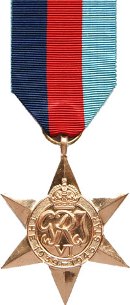
The 1939-45 Star is awarded for service between 3 September 1939 and 2 September 1945 for:
- a period of six months (180 days) operational service for RAN and Army personnel and RAAF non-air crew personnel;
- a period of two months operational service for air crew personnel; and/or
- a period of six months service at sea for Merchant Navy provided at least one voyage was made through one of the specified areas of active operations;
The 1939-45 Star is awarded to Australian Civilian Personnel who served afloat with the United States Army Small Ships Section between 8 December 1941 and 2 September 1945. Eligibility is the same as that for Merchant Navy personnel. See required evidence to support a claim.
Design
The six–pointed star is yellow copper zinc alloy. The obverse has a central design of the Royal and Imperial cypher, surmounted by a crown. The cypher is surrounded by a circlet containing the words "The 1939-45 Star".
Stars issued to Australian personnel have recipient names engraved on the plain reverse.
Ribbon
The ribbon has three vertical stripes of dark blue, red and light blue. The dark blue stripe represents the Naval Forces and the Merchant Navy, the red stripe the Armies and the light blue stripe the Air Forces.
Clasps
The "BATTLE OF BRITAIN" clasp was awarded to eligible air crew involved in the Battle of Britain.
The "BOMBER COMMAND" clasp was introduced in 2012 and is awarded to eligible Bomber Command aircrew.
When the ribbon is worn alone the standard silver rosette ribbon emblem is worn to denote the award of a clasp. The silver rosette emblem is not supplied by the Directorate of Honours and Awards.
Pacific Star
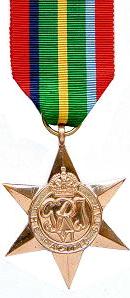
The Pacific Star is awarded for entry into operational service in the Pacific Theatre of Operations between 8 December 1941 and 2 September 1945.
Navy and Merchant Navy personnel are eligible if the 1939-45 Star is earned by six months service or if they entered the Pacific Theatre between 2 March 1945 and 2 September 1945.
The Pacific Star is awarded to Australian Civilian Personnel who served afloat with the United States Army Small Ships Section. Eligibility is the same as that for Merchant Navy personnel. See required evidence to support a claim.
Design
The six–pointed star is yellow copper zinc alloy. The obverse has a central design of the Royal and Imperial cypher, surmounted by a crown. The cypher is surrounded by a circlet containing the words 'The Pacific Star'.
Stars issued to Australian personnel have recipient names engraved on the plain reverse.
Ribbon
The ribbon has central yellow and green stripes that represent the forests and the beaches of the Pacific, flanked dark blue, light blue and red stripes that represent the service of the Naval Forces and Merchant Navy, the Air Forces and the Armies.
Clasp
The Burma clasp was issued for the Pacific Star.
When the ribbon is worn alone a silver rosette ribbon emblem is worn to denote the award of a clasp.
War Medal 1939-1945
[Extract from Defence Honours and Awards website -Imperial Awards
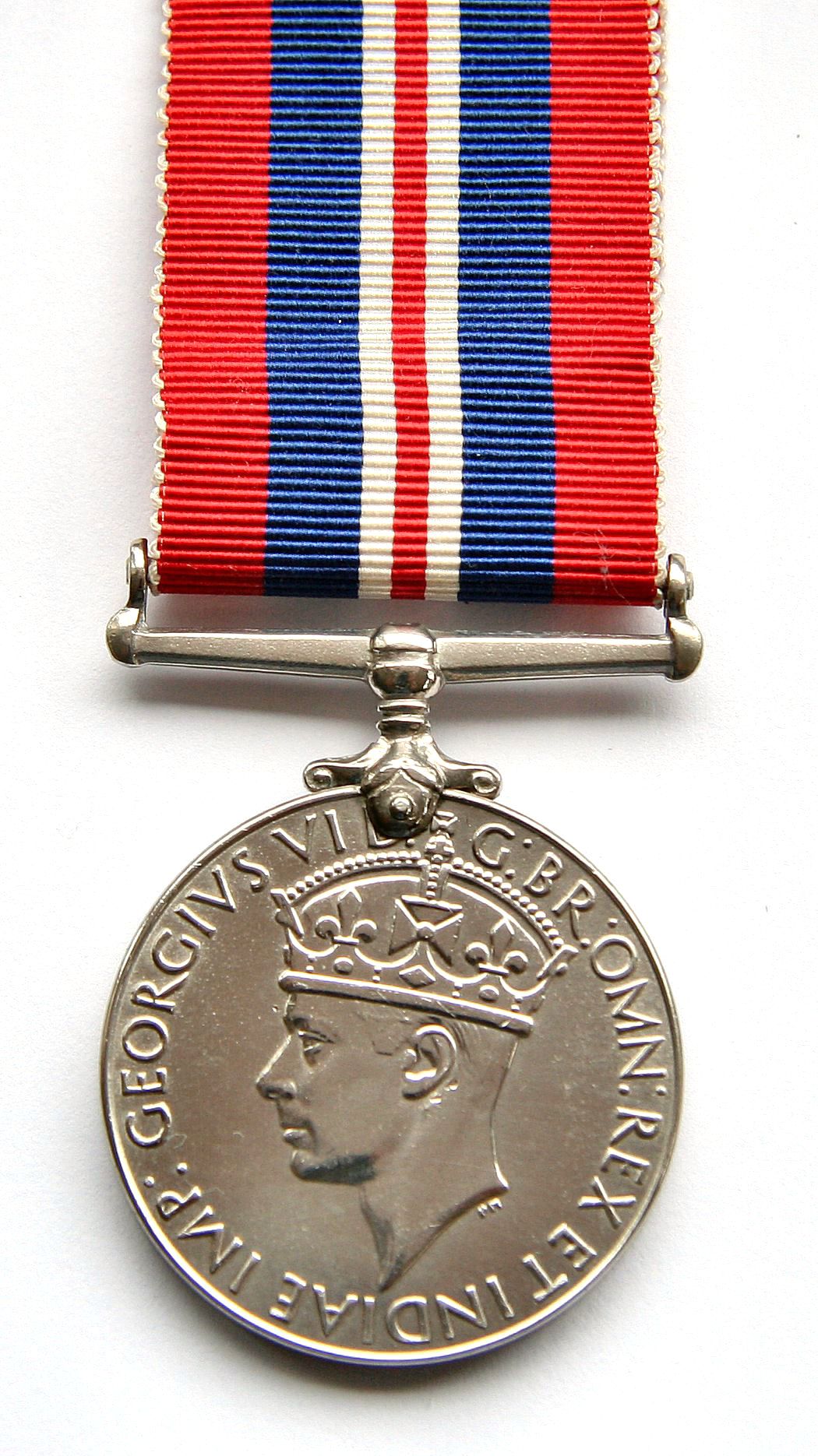
The medal is cupro-nickel with the crowned effigy of King George VI on the obverse.
The reverse has a lion standing on a double-headed dragon. The top of the reverse shows the dates 1939 and 1945.
The rim is plain, and the medal hangs from a suspender. The ribbon colours of red, white and blue represent the colours of the Union Flag.
The War Medal 1939-45 was awarded for 28 days full-time service in the Armed Forces between 3 September 1939 and 2 September 1945. Operational and non-operational service may be counted, providing that it was of 28 days or more duration.
In the Merchant Navy there is a requirement that the 28 days should have been served at sea.
A member qualifies for the award where service was brought to an end by death, wounds or other disabilities due to service or by cessation of hostilities on 2 September 1945.
The War Medal 1939-45 is awarded to Australian Civilian Personnel who served afloat with the United States Army Small Ships Section between 8 December 1941 and 2 September 1945. Eligibility is the same as that for Merchant Navy personnel.
Australia Service Medal 1939-1945
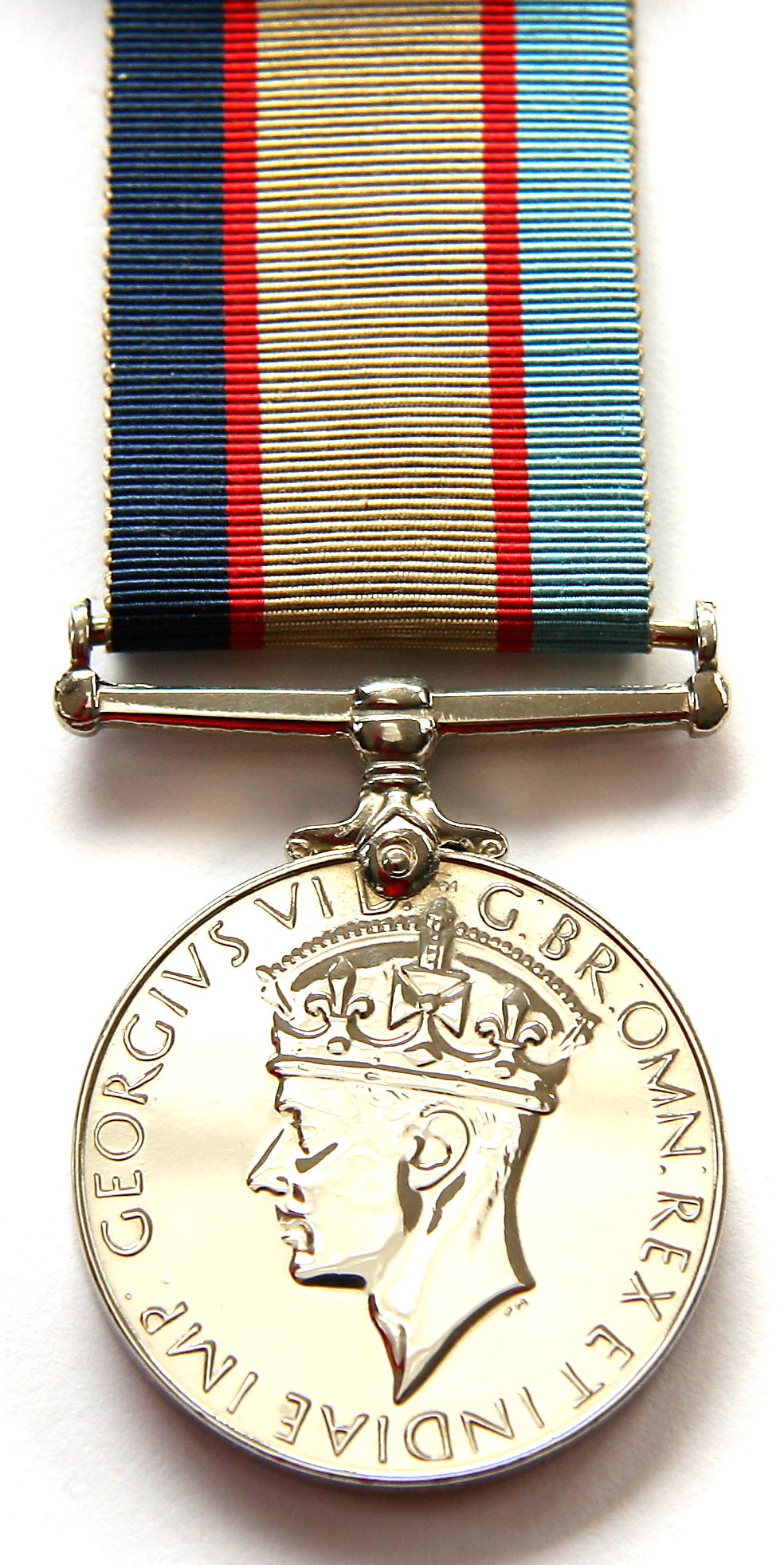
The Australia Service Medal 1939-1945 was instituted in 1949 to recognise the service of members of the Australian Armed Forces and the Australian Mercantile Marine during World War II.
The medal was originally awarded to those who served at home or overseas for at least 18 months full-time service, or three years part-time service, between 3 September 1939 and 2 September 1945. Members of the Australian Mercantile Marine must have served the qualifying time at sea.
In 1996 the qualifying time was reduced to 30 days full-time or 90 days part-time service. To be eligible for the medal a serviceman or woman must have been honourably discharged from the Australian Armed Forces.
Design
The medal is nickel silver with the crowned effigy of King George VI on the obverse. The reverse has the Australian coat of arms, placed centrally, surrounded by the words ‘THE AUSTRALIA SERVICE MEDAL 1939-1945’.
Ribbon
The ribbon has a wide khaki central stripe, flanked by two narrow red stripes, which are in turn flanked by two outer stripes, one of dark blue and the other of light blue. The khaki represents the Australian Army, and the red, dark blue and light blue represent the Merchant Navy, Royal Australian Navy and the Royal Australian Air Force respectively.
Attribution
The above information is from the Defence Honours site at http://www.defence.gov.au/Medals/Imperial/WWII/Australia-Service-Medal-1939-1945.asp, taken on 19 Jun 2019.